Sunday, February 25, 2007

Same Stooges. Different World. Finer Wine.

Music

Same Stooges. Different World. Finer Wine.

Steve Forrest/Insight-Visual, for The New York Times

Iggy Pop at the All Tomorrow’s Parties music festival in Minehead, England.


Published: February 25, 2007

THERE are the Stooges, from Ann Arbor, Mich., accidental inventors of punk, in the summer of 1970, on nationwide television. And there’s Iggy Pop, their singer: bare torso and sausage-casing jeans, silver gloves, dog collar, chipped front tooth.

Skip to next paragraph

Multimedia

Audio "1969" (mp3)
Audio "I Wanna Be Your Dog" (mp3)
Audio "No Fun" (mp3)
Audio "Down on the Street" (mp3)
Audio "TV Eye" (mp3)

Readers’ Opinions

Forum: Popular Music

Steve Forrest/Insight-Visual, for The New York Times

Iggy Pop backstage at a music festival in Minehead, England, in December. His only vice nowadays? A few glasses of Bordeaux, he says.

The song is “TV Eye,” and they have gotten wickedly good at their primitive groove — as good as they will ever get. Iggy weaves in and out of the beat: one second borne by the music, one second abstracted from it. Suddenly he does a violent knock-kneed dance and slips into the audience, gone except for his wounded-animal noises.

“There goes Iggy, right into the crowd,” says the host of the special NBC program “Midsummer Rock.” It’s Jack Lescoulie, an announcer on the “Today” show, the Al Roker of his day. In his late 50s he looks like the anti-Stooge: professional, good-natured, well fed, well insured.

After a commercial break we see Iggy crawling on the stage. “Since we broke away for our message, Iggy has been in the crowd and out again three different times,” Mr. Lescoulie says. “They seem to be enjoying it, and so does he.” The camera centers on a scrum of teenagers looking downward. Iggy surfaces, hoists himself up so he’s standing on shoulders, and remains aloft, pointing forward like the prow of a ship. Next he’s scooping something out of a jar, wiping it on himself, flinging it around. “That’s peanut butter,” Mr. Lescoulie says, incredulous.

I’M going to be straight,” Iggy Pop said recently, talking about that film, which circulated for years in certain circles and is now of course available on YouTube. “I was more than a little high.”

He was often more than a little high. But these days Iggy Pop, a k a Jim Osterberg, is ferociously grounded. He swims and practices a form of tai chi, and his only vice, he says, is a few glasses of Bordeaux. Coming up on his 60th birthday, he bears signs of age: creased and ropy, he limps from cartilage lost in his right hip, and can’t hear well over ambient noise.

For the first time in 34 years, however, he and the members of his onetime band are putting out a new record: “The Weirdness,” which will be released by Virgin on March 6. (Careful historians will say 37 years: this is the version of the Stooges that made “Fun House,” around the time of the peanut butter concert — the brothers Ron and Scott Asheton on guitar and drums and Steve Mackay on tenor saxophone.)

In the intervening years they too have changed. As has the world around them.

Once upon a time Iggy and the Stooges defined themselves against the Lescoulies of the world: they were outrageous, truculent, elemental. But these days it seems there are more Iggys than Lescoulies. Everyone’s subversive, everyone’s perverse. What can the Stooges be, if not a band that defines itself against the rest of the world? What happens when they’re old and experienced, and punk attitudes, already in their third generation, have infiltrated so many corners of the culture? How do they climb back into that frame of mind?

Video

More Video »

BREAKING up” doesn’t exist anymore. A band only has extended periods of downtime.

The Stooges’ downtime was a little more down than others. Ron Asheton used to say that Iggy had become too self-involved for the Stooges to play together again. Scott Asheton pursued Iggy at various points over the last 10 years, and the answer was always no. “I wasn’t going to go backwards,” Iggy explains now. “And I wasn’t going to do anything to what I thought was a great band.”

At some point, however, the incentives just became too powerful: prime gigs at the best rock festivals in the world, both the best-paid and the most creatively run.

Plus, what else was there to do? Scott Asheton, who lives in Florida, had been working in construction. His brother, Ron, had been in a series of bands that hadn’t made a stir, still living in his boyhood home on the west side of Ann Arbor, where the band had its first rehearsals. (All three went to Ann Arbor High together.)

Iggy needed the Ashetons just as much. “We managed to stay in a band together during a protracted period of failure,” he said of those early days, gigging and making records and living in a filthy house. “No rewards. No approval. No money. These are really the only guys I know. That doesn’t mean, ‘Oh, shucks, I like them so much.’ I mean, we lived together.”

Besides, “I’d hit a wall playing alone, in my solo music,” he said. “I was just at wit’s end about what to do — bands, songwriting, everything.”

He invited the Ashetons to work on a few songs with him for his album “Skull Ring” in 2003. A week after they convened, the Coachella Valley Music & Arts Festival floated the idea of a Stooges reunion show. (They did the show; Iggy wouldn’t say how much they were offered, though he does say that the Stooges now get paid much better than he did for concerts during his solo career.) And the bassist Mike Watt came on board, once of the Minutemen, to take the place of Dave Alexander, who died in 1975.

Before they all headed into the studio, Mr. Watt flew to Florida to go over the new songs, and Iggy gave him a lesson about finding his “inner stupidity.”
Today's Videos

SOFT BALLET meets Hirasawa Susumu

System of a Down-Hypnotize

Buck-Tick - Zangai (PV)

Cake - Motorcade of Generosity TV Special 1993

David Bowie - 1984/Dodo

The Only Ones - Another Girl Another Planet Music Video

BALZAC - "The Silence of the Crows" (Promo Video)

Iggy Pop and The Stooges - Tv Eye - AOL Sessions

Jethro Tull - Wind Up / Locomotive Breath

melvins - tv studio 1984!

dead kennedys - hyperactive child (in studio)

Aburadako live in 1983 (part 1)

Cake - I Will Survive

Monday, February 19, 2007

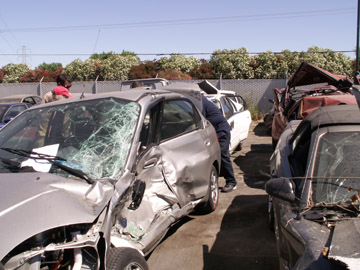
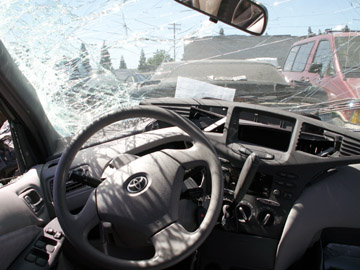
Mum's car after a drunk smashed into us


The Drunk was going around 50 in a 35 zone. Crossed 2 lanes of stopped traffic to the left turning lane (hit one car while doing this). Went straight & crashed his Dodge Ram Truck into my Mum's Prius - death on impact. The drunk continued finally stopping after smashing his truck into the face of a man stopped for the red light (this guy was going the opposite direction of the drunk). Total of seven cars were involved. Two people were sent to the hospital & one death. This was the drivers 3rd DUI, he had no injuries & tried to flee the scene.
The drunk is serving one year each for the two people he sent to the hospital (I was one of them). 2 years for killing my Mum - minus 8 months for taking the deal (It didn't go to trial he pled guilty). Then they 1/2 that for good behavior (he doesn't have to work for it they give it to him). So he's in prison for 1 year 8 months if he doesn't screw up.
So kids if you ever want to get revenge on someone – DO IT DRUNK! Perfect excuse – dang I was drunk I didn’t mean to do it! Shit as long as you don’t injure other people you probably only get 8 months (that’s with 2 DUI’s already).

Monday's Videos

CAKE - Comfort Eagle and Stickshifts and Safetybelts (Live)

CAKE Music Video "War Pigs" New song!

Elastica: Connection 1

Elastica: Connection 2

Media Youth Vs. Penicillin

The Slits - Babylon Is Corrupt

Gun Club - St. John`s Divine

Bunny Wailer - Jump Jump

The Clash In Munich- Complete Control & Hate and War

Live @ Slim's - The Pillows - Little Busters

Lene Lovich: Bird Song

Black Uhuru at Reggae Sunsplash 1984

REM "Losing My Religion" Live in France

Iggy Pop "Nightclubbing"

Chisato - Cyber Rose

Janis Joplin w. Big Brother and the Holding Company

CULTURE - International Herb

Divine: Walk Like A Man

Saturday, February 17, 2007

Buck-Tick live 1987-2005

Buck-Tick - Hyper Love 1987 Live

Buck Tick - Just One More Kiss [NHK Live Xmas '88]

Buck-Tick - Sexual XXXXX Live! 1988?

Buck-Tick - Aku no hana live @ Club Citta Kawasaki 1990

buck tick - die (live 1993)

BUCK-TICK1995POPJAM

Buck Tick "Gessekai" TV Live in July '98

BUCK-TICK2000BLITZDAMACY ??BLIT????

BUCK-TICK - DRESS live 2001

Buck-Tick - Long Distance Call (Live)2003

Buck-Tick - Devil & Freud - Jupiter Live 2004

Buck-Tick - Goblin 13th Floor With Diana Live 2005

Atsushi Sakurai-Sacrifice (live 2004)

Atsushi Sakurai-Yellow Pig (live 2004)

Buck-Tick Officail Web site


Sakurai Atsushi Official Web Site

Native American populations share gene signature

Native American populations share gene signature

  • 00:01 14 February 2007
  • NewScientist.com news service
  • Roxanne Khamsi
The proportion of people with the 9RA gene marker (indicated in red) is high throughout the Americas (image: Royal Society/Schroeder et al)

A distinctive, repeating sequence of DNA found in people living at the eastern edge of Russia is also widespread among Native Americans, according to a new study.

The finding lends support to the idea that Native Americans descended from a common founding population that lived near the Bering land bridge for some time.

Kari Schroeder at the University of California in Davis, US, and colleagues sampled the genes from various populations around the globe, including two at the eastern edge of Siberia, 53 elsewhere in Asia and 18 Native American populations. The study examined samples from roughly 1500 people in total, including 445 Native Americans.

The team looked for a series of nine repeating chunks of DNA, known as 9RA, which falls in a non-coding region of chromosome 9.

They found the 9RA sequence in at least one member of all the Native American populations tested, such as the Cherokee and Apache people. The two populations in eastern Siberia, where the Bering land bridge once connected Asia to North America, also tested positive for the 9RA sequence.

The 9RA sequence did not appear in any of the other Asian populations examined in the study, including those from other parts of Siberia, from Mongolia or Japan.

Multiple migrations?

According to Schroeder, the high prevalence of this gene marker among native populations of North and South America - and its absence in most of Asia - lends strong support to the idea that Native Americans can trace their ancestry to a common founding population.

The 9RA mutation probably occurred in an ancestral population located at the eastern edge of Siberia, which subsequently migrated over the Bering land bridge, Schroeder says (watch how the land bridge was gradually submerged as see levels rose). There may have been multiple migrations from this founding population, occurring thousands of years apart, she adds.

"How many times did people cross the Bering land bridge? That would be a very difficult question to answer," says Jeffrey Long at the University of Michigan Medical School in Ann Arbor, Michigan, US, who contributed to the new study.

Other experts have previously suggested that Native Americans do not share a common ancestry because of the linguistic and dental differences among populations.

Journal reference: Biology Letters (DOI: 10.1098/rsbl.2006.0609)

Friday, February 16, 2007

ULTRAVOX (from Fact magazine)

ULTRAVOX

Although they are one of the most important British art rock bands, Ultravox have always been ignored or sneered at in the UK. But with re-mastered versions of their first three LPs just re-released, featuring extra tracks and sleeve notes, K-Punk reckons it’s long past time to rescue their legacy as synthetic rock pioneers...

It is the Mark II version of Ultravox, fronted by Midge Ure, which tends to be remembered and dismissed as a moment of 1980s indulgence and pomposity. That judgement is unfair – the impact of the Ure-led Ultravox on techno and house, for instance, should not be underestimated - but it is the first three Ultravox albums, recorded when the band were led by John Foxx, that have been most scandalously neglected.

Foxx was more than the band’s singer. He conceived of Ultravox not as a rock band but a design concept, and he meticulously co-ordinated all aspects of the band’s production – image and words as well as sound – to produce a consistent ‘sonic fiction’. Foxx’s striking sleeve designs are as important as the music (as Peter Saville told me in the interview in last issue’s FACT, Foxx’s cover art for ‘Systems of Romance’ was an important influence on his own work for Factory).


The first self-titled Ultravox LP, released in 1977, is like art rock on punk amphetamines. Tracks like ‘Wide Boys’ and ‘Satday Night in the City of the Dead’ are lurid vignettes of a late 1970s London lurching into social collapse. Brian Eno produced the LP, and early Roxy were a clear reference point, their shiny plastic surfaces Velvets-slashed and Dolls-scuzzed for ‘77 (it is interesting to compare what Japan did with similar co-ordinates on their first album). Ultravox were too arty, too conceptual, to be punk-fashionable, and the album would be no more than a particularly fascinating souvenir of ‘77 were it not for its closing track, 'My Sex.'

'My Sex' is like cyber-theorist Donna Haraway's Cyborg Manifesto nigh-on a decade ahead of time, and better - Ballard's condensed novels further compressed and spliced with Burroughs/ Warhol in a simulation of a post-social(ist) ex-human POV. The vocal - tentative, thin, distant - is less sung than (newsreel) reported, a radio-signal beamed back from the near-future. And the music - a sparse, plaintive, Satie-electric piano fugue - plays like nostalgia from an era (then) yet to come - the lost/ last sounds of the human echoing in the abandoned brutalist precincts of an alternate 1980s.

Kraftwerk had patented the emotionless in pop. But their Robots were Asimov-SF: smoothly efficient industrial machines, oddly quaint, almost old-fashioned, redolent of the Fritz Lang twenties. ‘My Sex’ is cyber-punk to Kraftwerk’s Science Fiction: Foxx's sex/ sect were messily cyborgian, grafts not quite taken, machine-human, Ballard-abstract collages rather than smooth fusions: “My sex is … suburban photographs/ skyscraper shadows/ on/ a carcrash overpass.”

The second Ultravox LP – ‘ha! ha! ha!’ - is a much harsher proposition. It is like ‘For Your Pleasure’ graffitied by Francis Bacon and collage-hacked by John Heartfield and ‘White Light/ White Heat’ cut-and-pasted with apocalyptic-speculative newspapers from ’77. Songs - ‘The Frozen Ones’, ‘Distant Smile’, ‘Fear in the Western World’, ‘Artificial Life’ – are hideous Steadman-distorted polaroids of a decadent metropolis. Moments of glacial calm are suddenly jump-started by an amphetamine-agitated electro-punk that forever teeters on the edge of total disarray, lurching now and then into an atonal collapse that - because of Billy Currie’s frenzied strings and abstrakt electronics - is more Penderecki than Pistols. After this, the desolate beauty of ‘Hiroshima Mon Amour’ - Resnais and Duras rescored as mutant synthezoid jazz – seems genuinely, eerily post-atomic.

1978’s ‘Systems of Romance’ sees the Ultravox sound re-branded yet again. ‘Systems…’ is more closely aligned with a post-Bowie, pre-New Romantic disco-rock sound than any of the previous albums. Robin Simon’s guitar has a similar liquid metallic quality reminiscent of Carlos Alomar’s, and Connie Plank’s production smoothly integrated electronics with conventional instrumentation much in the way that Eno had on ‘Low’. But Foxx sounds more like a post-traumatic Lennon than Bowie. The Beatles are a definite, if subterranean, presence here, and one of the innovative features of ‘Systems…’ is its recovery and reinvention of psychedelia: there’s an (unused) template for a future-shock rock here that takes up from where the Beatles left off, rather than lazily rehashing them.

The track ‘Slow Motion’ is the outstanding example of this new, electronic pyschedelia. ‘Slow Motion’ describes those moments when successive time melts (away) into longing, producing an affect somewhere between yearning and bliss. This is one of Foxx’s signature moods: a feeling in which all definite edges and boundaries smooth away, ‘blurring [your] face and conversation’. ‘Systems of Romance’ explores psychedelic topographies again in ‘When You Walk Through Me’ (the drum pattern of which, Warren Cann subsequently admitted, was stolen from ‘Tomorrow Never Knows’) and in the identity-migration scenarios of ‘Can’t Stay Long’ and ‘Someone Else’s Clothes’: “check out some memories I don’t recognize.”

‘Dislocation’ is the inverse of this: the dark psychedelia of mental disintegration, from a Poe coma-zone of catatonia and amnesia, between wakefulness and sleep, life and undeath. Rock is not so much refitted as superceded here, its instrumentation replaced by ominous electronic textures: ‘Dislocation’’s insistent repeating figure, like an android spine being played as percussion, is in reality a heavily treated, FXed sound from Currie’s ARP synth.

‘Quiet Men’ is disco-rock, another of Foxx’s condensed sonic-fictions. The quiet men – those who observe, but don’t act – were Foxx’s vision of alien(ated)-anonymity as liberation. (The concept was inspired by Foxx’s buying of a second-hand grey suit, which he would wear as an art experiment in invisibility, a deliberate attempt to merge with the crowd.)

‘Systems of Romance’ produced a template for synthetic rock that Gary Numan, Duran Duran and others would follow. In Chicago and Detroit, the future producers of techno and house also listened attentively. This was rock from the future, all the more compelling at a time – now - when groups reheating twenty-five year old ideas are being sold to us as new.

Words: K-Punk
Check: http://k-punk.abstractdynamics.org/

The Punk Rock Years


The Punk Years - #1 - Wham Bam Thank You Glam (part 1/3)

The Punk Years - #1 - Wham Bam Thank You Glam (part 2/3)

The Punk Years - #1 - Wham Bam Thank You Glam (part 3/3)

The Punk Years - #2 - Year Zero (part 1/3)

The Punk Years - #2 - Year Zero (part 2/3)

The Punk Years - #2 - Year Zero (part 3/3)

The Punk Years - #3 - 1977 Never Get To Heaven (part 1/3)

The Punk Years - #3 - 1977 Never Get To Heaven (part 2/3)

The Punk Years - #3 - 1977 Never Get To Heaven (part 3/3)

The Punk Years - #4 - Take Three Chords (part 1/3)

The Punk Years - #4 - Take Three Chords (part 2/3)

The Punk Years - #4 - Take Three Chords (part 3/3)

The Punk Years - #5 - A Riot of Our Own (part 1/3)

The Punk Years - #5 - A Riot of Our Own (part 2/3)

The Punk Years - #5 - A Riot of Our Own (part 3/3)

The Punk Years - #6 - Typical Girls (part 1/3)

The Punk Years - #6 - Typical Girls (part 2/3)

The Punk Years - #6 - Typical Girls (part 3/3)

The Punk Years - #7 - RidiculeIsNothingToBeScaredOf (part 1/3)

The Punk Years - #7 - RidiculeIsNothingToBeScaredOf (part 2/3)

The Punk Years - #7 - RidiculeIsNothingToBeScaredOf (part 3/3)

The Punk Years - #8 - Punx Not Dead (part 1/3)

The Punk Years - #8 - Punx Not Dead (part 2/3)

The Punk Years - #8 - Punx Not Dead (part 3/3)

The Punk Years - #9 - Independents Days (part 1/3)

The Punk Years - #9 - Independents Days (part 2/3)

The Punk Years - #9 - Independents Days (part 3/3)

Friday, February 09, 2007

Tuesday, January 30, 2007

bizarro

What will Hermione say, Harry?

What will Hermione say, Harry?

Last updated at 11:44am on 30th January 2007

Comments Comments (27)

Divested of his clothes, not to mention the lightning scar on his forehead, this is Harry Potter a million miles from Hogwarts.

Between filming the fifth and sixth Potter movies, 17-year-old Daniel Radcliffe is appearing on the West End stage in a revival of Peter Shaffer's controversial play Equus.

SCROLL DOWN FOR MORE

He plays troubled stablehand Alan Strang and is involved in a lengthy nude sex scene with former Holby City actress Joanna Christie.

Radcliffe was clearly keen to impress with his physique, pumping up his slender frame in the gym for seven hours a week.

But whether his young fans will be impressed by his transition from Hermione Granger's boy wizard friend to hunky sex symbol remains to be seen.

Websites were receiving e-mails from parents worried about Radcliffe's appearance in the play, which will be open to children despite its explicit adult content.

One said: 'We as parents feel Daniel should not appear nude. Our nine-year-old son looks up to him as a role model. We are very disappointed and will avoid the future movies he makes.'

Another wrote: 'I am curious as to how and why his parents said this was okay.'

The play opens at the Gielgud Theatre on February 27 and has already attracted advance bookings worth £1million.

Radcliffe has been rehearsing his nude scene for a week with his female co-star and although he was 'a little hesitant and shy' at first, he had overcome his embarrassment, said producer David Pugh.

He added: 'Equus is on the school syllabus and I would never stipulate what age people should be to see it.'

Radcliffe's spokesman Vanessa Davies said: 'Daniel does not want to step away from Harry Potter but he does want to show he is an rounded actor capable of very different and diverse roles.

'He has tremendous support from Harry Potter fans.'

Equus opened in the West End in 1973 to huge controversy. It was followed in 1977 by a movie version in which Peter Firth played Alan and Jenny Agutter played his girlfriend Jill, both appearing full frontally nude.

Miss Agutter also features in the 2007 version - as a judge with her clothes on.

Sunday, January 21, 2007

Early Social Distortion bassist ID'd in wreck

Sunday, January 21, 2007
Early Social Distortion bassist ID'd in wreck
Officials say that Brent Liles of Fullerton was bicyclist killed in Placentia crash.
By ERIC CARPENTER
The Orange County Register

PLACENTIA – Officials on Saturday identified Brent Liles of Fullerton, former bass guitarist in one of the region's most influential punk rock bands, Social Distortion, as the bicyclist killed by a big rig on Thursday.

Liles played bass on the group's groundbreaking "Mommy's Little Monster" recording in 1983 and went on to play with other well-known Orange County punk acts such as the group Agent Orange. He was 43.

"Brent was a fun-loving guy who approached his bass playing with a lot of enthusiasm and that made him a lot of fun to be around," said Frank Agnew, a fellow musician and friend.

Liles, wearing casual clothing, was riding a small dirt bicycle westbound on Orangethorpe Avenue just after 11:30 a.m. Thursday, California Highway Patrol officials said.

As he entered the crosswalk at the Orange (57) Freeway, a big rig carrying a trailer turned right onto the on-ramp and accelerated, hitting Liles. He was pronounced dead at the scene, officials said.

The driver, Javier Lopez of Rancho Cucamonga, was turning on a green light. He was not immediately cited, CHP officials said. The crash is still being investigated.

Liles joined Social Distortion in 1981 after a tumultuous beginning for the band, whose original members came from Fullerton and Huntington Beach.

He was recruited to play bass on "Mommy's Little Monster," which quickly brought the band national acclaim for its hard-driving music, raw vocals and themes of suburban alienation.

Orange County Register pop music critic Ben Wener called the album a "fundamental work" that set the groundwork for the West Coast punk rock scene.

Liles was featured in the limited-release film "Another State of Mind," which documented the band's early struggles on the road touring the United States and Canada in a pieced-together tour van.

Fed up with the band's internal turmoil, Liles abruptly left Social Distortion with drummer Derek O'Brien during a legendary New Year's Eve gig in 1983. The band soldiered on and garnered more widespread fame and even some pop-radio success under original frontman Mike Ness.

Ness did not return a phone call to his management company seeking comment.

Fans of Social Distortion said Liles was an important part of the band's history and he'll be sadly missed. The band's guitarist Dennis Dannell, who played with Liles, died of a brain aneurism in February 2000. The band continues on with a new lineup.

"I think most people think of Social D. and they think of Mike Ness. But they never could be what they are without some great supporting characters like Brent," said Sara Pendergast, 41, a longtime fan of the band.

"For people who love their music, it's like losing a member of the extended family."

Contact the writer: 714-704-3769 or ecarpenter@ocregister.com

Today's Videos

Tito & Tarantula - Angry cockroach

Break the cycle-TRANSTIC NERVE ( from LIVE FILM vol.1 )

Zager & Evans - In the Year 2525 (Beat Club 1969)

Buck-Tick - Sasayaki (SSL)

bauhaus - spirit

MUCC-kokoro no nai machi

Rancid-time bomb

hide & L7 - Doubt (PV)

das ich - die propheten (live)

The Beat (Live 1979)

DOING LIFE live

L'Arc~en~Ciel - STAY AWAY [REALIVE]

The Monkees - I'm Not Your Steppin' Stone

Pierrot Creature PV

The Transplants, Diamonds and Guns

blondie - atomic

lacrimosa - alleine zu zweit (live)

the donnas-strutter

Monday, January 08, 2007

Sixty years of ch-ch-changes for David Bowie

by CHRISTOPHER SANDFORD Last updated at 11:00am on 8th January 2007

Reader comments (7)
David Bowie
David Bowie

Alter ego: Bowie as Ziggy Stardust


Around this time every year, the Hollywood trade press begins to fill with full-page advertisements from the major studios, rather quaintly 'recommending' or, if they are already successful at the box office, 'congratulating' a particular film or actor.

See more pictures of David Bowie's career here

The campaign is less of a public service and more a timely reminder to the voting members of the Academy of Motion Pictures, before that mysterious body announces its annual Oscar nominations.

This year, among the leading contenders in the category of Best Supporting Actor is David Bowie, for his role in the critically acclaimed thriller The Prestige.

Playing a portly-looking character in an Edwardian frock coat is just the latest in a seemingly endless series of reincarnations for the artist formerly known as Ziggy Stardust and, later, the Thin White Duke.

Already a veteran of 15 films, countless albums, soundtracks and record-breaking concert tours, he's in no danger of slowing down as he celebrates his 60th birthday today.

As one close friend told me, the word 'frenetic' can't begin to describe Bowie's lifestyle. 'He'll typically have six jobs going at once, and he's a master at blocking out the outside world. Phones ring and messages aren't returned. Texts only occasionally receive replies.

"He'll get around to dealing with what he feels is most important in the pile and he'll always show up for a mate, but basically you join the queue. His energy level is off the scale."

It is this energy and drive which has kept him at the top in rock music for more than 30 years - and it has allowed him to carry off the most remarkable series of character changes and leave many of his contemporaries behind.

But have these changes simply been good examples of astute marketing and showbiz flamboyance, or is there a darker side to Bowie's ever-changing personality, rooted in the history of mental illness which blighted his family?

Born in Brixton, south London, on January 8, 1947, Bowie was christened David Robert Jones. It was another 18 years before he adopted his better known alias, partly in homage to the Texan hero who popularised the double-edged knife, and partly to avoid being confused with Davy Jones of the Monkees.

David's father, John Jones, had a raffish side, and once disastrously owned a London piano bar named The Boop-ADoop, but he seems to have settled down with age, becoming a promotions officer for the charity Barnardo's.

David's mother, Peggy, a former cinema usher, was more colourful. According to several reliable witnesses and institutional records, there was more than a streak of mental instability in her family. Bowie's Aunt Una suffered from clinical depression and schizophrenia, underwent electric shock treatment and died in her late 30s.

A second aunt, Vivienne, suffered a schizophrenic attack, and a third, Nora, was lobotomised in an effort to cure what her mother described as 'bad nerves'.

Of Peggy's two remaining siblings, a brother won a Military Medal for heroism in which he showed 'utter disregard for his own life' in the North African desert, and a fourth sister, Pat (described by Bowie as a 'frightful aunt) was cast as the family rabble-rouser.

In 1937, after a brief affair with a bartender before she was married, Peggy gave birth to a son, Terry Burns. Some ten years later, Terry moved into the Jones household in Stansfield Road, Brixton, where he slept in the bed next to the newborn David.

He became his half-brother's role model, introducing him to the world of modern jazz and Beat authors such as Jack Kerouac. Peggy's sister, Pat, said: "David worshipped Terry, and Terry idolised him."

Unfortunately, the family "condition", as it was known, was again at work. In his mid-20s, Terry was diagnosed as a manic depressive and schizophrenic, and was eventually institutionalised.

One snowy morning in January 1985, he climbed over the wall of a psychiatric hospital in Surrey and walked to the nearby station, where he lay down on the track directly in the path of the oncoming London express train.

Terry was 47. David didn't attend the funeral but sent a wreath of roses and a card which read: "You've seen more things than we could imagine but all these moments will be lost, like tears washed away by the rain. God bless you - David."

Eight years later Bowie admitted: "It scared me. I felt my own mind was in question. I often wondered how near the line I was going - how far I should push myself."

Ziggy and the other characters, he explained, had been "alternative egos", a form of madness through which he had meant to preserve his sanity.

David Bowie never crossed the divide into mental illness. But he shared a number of the quirks shown by his maternal family. He would suddenly burst into tears, for example, and was said to have had a particularly active imagination.

One family friend told me that, as a four or five-year-old, David had phoned to summon the local ambulance one night, and successfully persuaded the operator that he was "dying".

That Bowie was conscious of his heritage seems obvious from the number of songs he wrote touching on lunacy or schizophrenia. Of the Oh! You Pretty Things lyrics, Bowie said: "I hadn't been to an analyst - my parents went, my brothers and sisters and my aunts and uncles and cousins, they did that. They ended up in a much worse state. I thought I'd write my problems out."

Bowie released his first single at the age of 17, as part of a group called The King Bees, in June 1964. In the late Sixties he was a regular performer at the Three Tuns pub in Beckenham, south London.

After a minor success with the 1969 song Space Oddity, Bowie's big break came with his introduction to a 26-year-old litigation clerk and would-be showbusiness agent named Tony DeFries.

Within a few months, he'd transformed Bowie's finances by renegotiating his publishing contract, transferring it from Essex Music to Chrysalis Music for a £5,000 advance, more than £50,000 today.

DeFries set up a company called Titanic Music, to administer a uniquely generous royalty rate of 75 per cent. After shaking hands in the boardroom with DeFries and the three Chrysalis directors, Bowie walked back to Trident Studios in Soho, where he blurted out to the first person he met (the cleaner) that he was "a star". That night at home in Beckenham he is said to have broken down and cried.

DeFries' entrepreneurial skills were matched by Bowie's astonishing sequence of songs, beginning with the 1971 album Hunky Dory. His genius was to take unpromising themes like sexual confusion and set them to catchy tunes.

His accompanying stage persona remains among the best loved, and most frequently imitated, of all his creations.

The Bowie of 1972-3 typically sported a wardrobe of red plastic boots, eyewateringly tight trousers, see-through blouses and glittering, sequinned jackets. The whole ensemble was topped off by a red cockade that became Ziggy's bestknown symbol, and that regularly led the list of great rock haircuts.

Bowie would later dismiss the look as "a cross between Nijinsky and Woolworths", something cobbled together from whatever was lying about.

The Ziggy character seemed to be genderless, an impression Bowie fuelled in a January 1972 interview in which he announced, "I'm gay, and always have been." However, Mary Finnigan, with whom Bowie had an affair in 1969, would insist that "David was more into women than men. Homosexuality with him was more opportunist and contrived." A number of other partners similarly agree that, while physically androgynous, Bowie was as 'straight' as they came.

In March 1970, Bowie married Angela Barnett, who described having met him through a mutual boyfriend whom "we were both f***ing". A year later, she gave birth to a son, whom they named Duncan Zowie Haywood Jones.

Having killed off the Ziggy character, Bowie produced his first No 1 album with the punning title Aladdin Sane. He reinvented himself as a soul singer, then as an unlikely duettist with Bing Crosby.

In 1976, he starred in the critically acclaimed sci-fi film The Man Who Fell To Earth. But another personality reinvention was looming.

Commenting on Britain's latest economic crisis, Bowie told a reporter: "I believe very strongly in Fascism. The only way we can speed up the sort of liberalism that's hanging foul in the air at the moment is to speed up the progress of a Right-wing, totally dictatorial tyranny and get it over as fast as possible."

Bowie subsequently explained his remarks were "a joke", although days later he treated his fans to a surprising spectacle on his arrival by the Orient Express at Victoria station in London. After the train pulled to a stop, Bowie walked to a waiting opentopped Mercedes, got in, stood up and thrust out his right arm in an apparent Nazi salute.

The Eighties were a quieter, but highly lucrative time for Bowie, who spent much of the decade in tax exile in Switzerland. He divorced Angela, and in 1983, reemerged with his chart-topping album Let's Dance and an accompanying tour, which was seen by three million fans around the world. This netted him £8m.

In 1992, Bowie married the Somalian model and actress Iman Abdul Majid. The couple, who have a young daughter, spend most of their time in New York.

In 1997 Bowie became the first major artist to turn himself into a Wall Street share issue. The so-called 'Bowie bond', which gave investors the chance to own a part of songs such as Rebel Rebel, was an instant sell-out, and reportedly put some £30m in Bowie's bank account.

Despite a personal wealth which is put at more than £100m, Bowie dismisses talk of his retirement.The only thing that could effect his future plans is his health.

There were warning signs in July 2004, when he pulled out of a European concert tour in Germany after complaining of shoulder pain. He underwent emergency surgery for an acutely blocked artery. He blamed the problem - which he later described as a minor heart attack - on years of heavy smoking and touring. He returned to New York to recuperate.

Now recovered, Bowie told friends he might revive his Ziggy Stardust persona. He will be selecting artists and performing at the High Line Festival in New York in May. And although he has made guest appearances with other artists such as David Gilmour and Arcade Fire, it will be his first proper show since his cancelled European tour.

His acting career, however, continues with his role in The Prestige and a guest appearance on Ricky Gervais's comedy series, Extras.

It's curiously tempting to bet on him surprising us all with at least one more of his classic reinventions, particularly as Tony Blair, a known fan, prepares to leave office.

In 2000, he was reported to have turned down the offer of a CBE in the Queen's birthday honours list. But now perhaps, after giving us Ziggy and other characters over the years, could this pop-music chameleon emerge as Sir David Bowie?

• Christopher Sandford's biography Bowie: Loving The Alien, is available in paperback published by Warner Books at £7.99.

Sunday, January 07, 2007

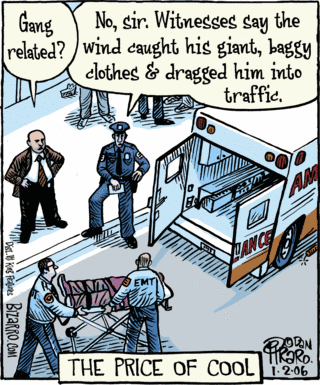
The Price of Cool

Sunday's videos

Stuck in myself-TRANSTIC NERVE ( from LIVE FILM vol.1 )

X- RAY SPEX IDENTITY LIVE

System of a down - Aerial

BUCK-TICK - ICONOCLASM&TOKYO (NHK X'mas Special)

joy division - transmission

Sublime doin time

The Slits - New Town

sugizo- no more machineguns play the guitar

NOFX triplerock

MUCC's Gerbera Live

The Damned - Alone Again Or

Conservative Christian says God has predicted US slaughter


ANDY SULLIVAN IN WASHINGTON

PAT Robertson, an American Conservative Christian broadcaster says God told him a terrorist attack will result in "mass killing" in the United States in the second half of 2007.

I'm not saying necessarily nuclear, the Lord didn't say nuclear

"I'm not saying necessarily nuclear, the Lord didn't say nuclear," Mr Robertson said on his television show The 700 Club. "It'll be mass killing, possibly millions of people, major cities.

"The evil people will come after this country and there's a possibility, not a possibility, a definite certainty, that chaos is going to rule."

Mr Robertson told viewers they should not be afraid because "if you get blown up or something, you go to heaven; that's the worst thing that will happen to you".

He said God conveyed this message to him during an annual prayer retreat. He said he has received other messages during past retreats.

The broadcaster's 2006 forecast of heavy storm damage in coastal areas was followed by the second-lightest hurricane season since 1995. However, he said his prediction was borne out by storms in New England, Denver, the Pacific Northwest and the Philippines.

God did not warn him of any natural disasters this year, he said.

Mr Robertson, 76, reaches about a million viewers daily on the Christian Broadcasting Network, which he founded. He is credited for helping to shape political views of evangelical Christians, a vibrant force in the Republican Party, and campaigned for the presidency as a Republican in 1988.

He claims on his website that he can leg-press 2,000lb, thanks to an energy drink he promotes.


Robertson Says He Leg-Pressed 2,000 Pounds

Many evangelicals cringe at doomsayer's prophecies Pat Robertson draws viewers, but pastors say his remarks make Christians look bad